
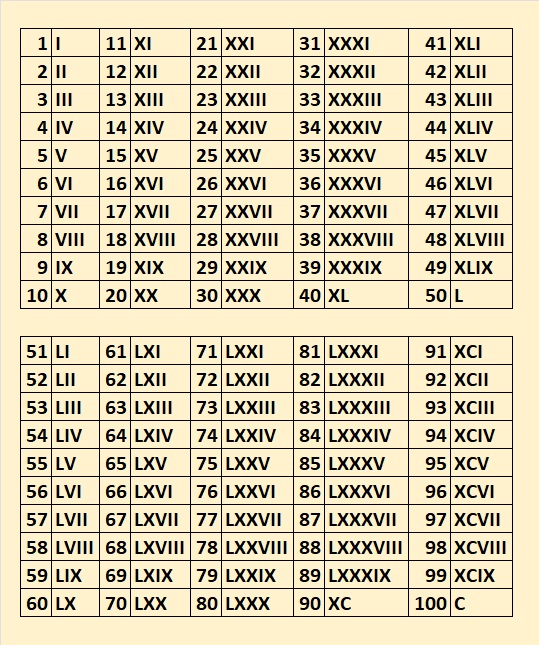
Roman numerals use letters instead of the place-value digits used by the modern decimal system. The most important symbols are I, V, X, L, C, D, and M. Once these values are familiar, the numbers from 1 to 100 become straightforward to read and write.
Roman numeral symbols
| Symbol | Value |
|---|---|
| I | 1 |
| V | 5 |
| X | 10 |
| L | 50 |
| C | 100 |
| D | 500 |
| M | 1,000 |
How to read the chart
Most Roman numerals are formed by adding symbols from left to right. For example, VIII is 5 + 1 + 1 + 1, which equals 8. Symbols are normally arranged from larger values to smaller values.
Subtractive notation changes that rule when a smaller symbol appears before a larger one. IV means 5 − 1 = 4, while IX means 10 − 1 = 9.
Important numbers from 1 to 100
| Number | Roman numeral | How it is formed |
|---|---|---|
| 4 | IV | 5 − 1 |
| 9 | IX | 10 − 1 |
| 40 | XL | 50 − 10 |
| 49 | XLIX | 40 + 9 |
| 50 | L | 50 |
| 90 | XC | 100 − 10 |
| 99 | XCIX | 90 + 9 |
| 100 | C | 100 |
Convert any value instantly
For a fast conversion, use the Roman Numeral Converter. It converts numbers to canonical Roman numerals and validates Roman numeral input before converting it back to a number.